





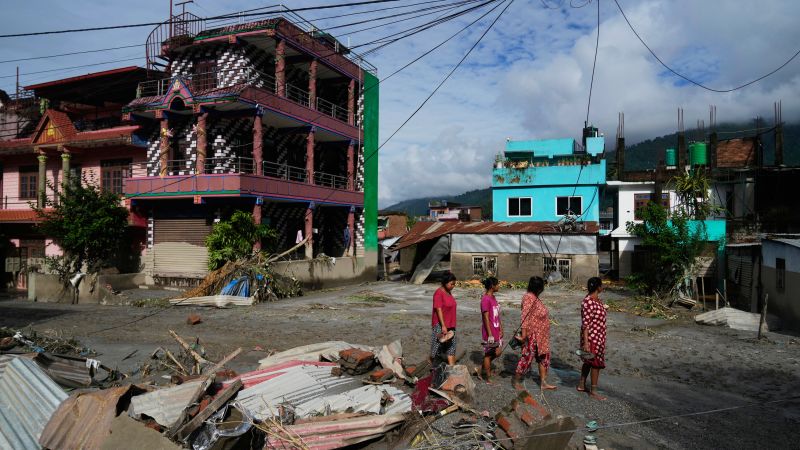
Kathmandu, Nepal – A catastrophic flood has gripped Nepal, triggering a desperate search for over 1,300 missing individuals after devastating rainfall overwhelmed a Chinese-Nepalese border region. The situation has escalated dramatically following the collapse of a secondary threat – torrential rain expected in China’s Gyirong County, where fears of a dam breach could further exacerbate the situation. The disaster, compounded by a rapidly deteriorating climate, has fueled a frantic search underway for more than 1,300 people, with the US government offering assistance to Nepal. Scientists are still working to determine the precise cause of the disaster, with video footage posted on Chinese social media showing a significant portion of a glacier breaking off a mountain and plunging approximately 7,000 feet into the river below. The resulting wave, pulverized ice and rock traveled nearly 14 miles in under 7 minutes, according to a planetary scientist. CNN journalists are outside a hospital in Kathmandu, where families are lining up to register the names of their missing loved ones, and more than 1,200 people have been registered as missing in the flood disaster, according to a local police officer operating the desk outside the Tribhuvan University Teaching Hospital. Families are also checking paper notices taped to the wall listing 31 injured survivors who are being treated in the hospital. Nepali filmmaker Tashi Bista has been utilizing thermal drones to aid in rescue efforts, speaking to CNN’s Anderson Cooper about the devastating destruction he has witnessed and the challenges involved in finding survivors. Video shared by a photographer on Chinese social media and geolocated by CNN captures where a large portion of glacier near Langtang Lirung peak broke along the Nepal-China border, causing a devastating avalanche and landslide. From there, it plunged to the river below — a roughly 7,000-foot vertical drop, a CNN analysis shows. Though information on the volume of rock and ice that fell is not yet available, the section of the glacier that fell is approximately 2,000 feet wide, with a similarly sized section of rock next to it falling as well. The sheared glacier left a 3,000-foot-wide gash in the mountainside, according to CNN analysis of satellite imagery. The flood wave – a cascade of water, pulverized ice and rock – ‘descended the first 22 kilometers (13.7 miles) at an average speed of 193 kilometers per hour (120 mph),” said Jeffrey Kargel, a senior scientist at the Planetary Science Institute, a non-profit institute. That means it traveled nearly 14 miles in just 6 minutes and 50 seconds. Scientists are still unpicking the exact causes of the devastating flooding. CNN’s Laura Paddison and Thomas Bordeaux contributed reporting. The threat of further landslides and flooding along the devastated Nepal-China border is making a difficult search for survivors even more dangerous, the Red Cross told CNN. “We’re extremely concerned about the possibility of a renewed flood, even as the authorities are working very, very hard to reopen roads that have been blocked for communities that have still not received significant assistance,” said David Fisher, Head of the International Federation of the Red Cross (IFRC) for Nepal. Two days after the disaster, many people in the flood zone are ‘still very disoriented,’ and rescuers and volunteers are doing their best to distribute flood warnings to people still in shock, Fisher told CNN. “It’s critical that we reach both the existing emergency needs and that we get these warnings out as soon as possible,” he said of his friends. Pokharel, an engineering professor at the University of Texas at San Antonio, compared the size of the glacier to ‘liquid cement’ and said the debris could hold water for a long time, making it ‘treacherously variable.’ It’s difficult to pinpoint exactly where the most drenching downpours will occur, but the hardest-hit areas could experience them, which could challenge search and recovery efforts. Nepal’s monsoon typically lasts from June through September. The country sees about 80% of its rainfall during this time. Here’s what the radar looks like through Saturday, local time: The flooding along the Chinese-Nepalese border on Wednesday hit a popular route for pilgrims and tourists. Trump went on to say that around 50 to 60 Americans are missing but said that he hasn’t received the full list yet. “Oh, it’s terrible,” Trump said when asked Thursday afternoon about the flood and missing Americans. “Nobody’s ever seen anything quite like that where very powerful, strong, well-built buildings were wiped out like they were toothpicks,” he added during an Oval Office event. Trump went on to say that around 50 to 60 Americans are missing but said that he hasn’t received the full list yet. CNN has reported that more than 1,300 people are missing following the floods in Nepal, including at least 700 foreigners from two dozen countries. The death toll in Nepal has climbed to more than 350 people. The crisis has raised concerns about the potential for further landslides and the impact on the region’s fragile ecosystem.”}” , 1,200, 1,300, 700, 350, 1,200
Source: CNN