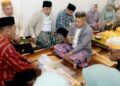







The New Patriotic Party’s (NPP) recent successful regional executive elections represent a pivotal moment in the party’s trajectory, marking a significant step toward reclaiming its position as a dominant force in Ghanaian politics. This isn’t merely an internal housekeeping exercise; it’s a calculated strategic test, designed to assess the party’s ambition to recapture power from the National Democratic Congress (NDC) in 2028. As Dr. Mahamudu Bawumia aptly stated, “The goal for all of us is to win the 2028 elections.” The 2028 flagbearer, Dr. Mahamudu Bawumia, emphasized this point, highlighting the need for a robust and sustained campaign. However, the crucial question remains whether the newly appointed regional leadership can translate the structure of the executive into tangible political gains – the seats of parliament.
Following the completion of polling station, electoral area, constituency, and regional elections, the NPP’s organization has been significantly reorganized. The post-2024 data reveals a party that has experienced a substantial decline in ground strength, particularly in the regions that historically held significant sway. A concerning trend is the region with the steepest losses, with the post-2024 data showing a significant reduction in parliamentary seats compared to 2016. Specifically, the region experienced a dramatic shift, with the collapse of the most significant parliamentary seats in 2016 to just five in 2024. This represents a stark contrast to the party’s traditional swing zones.
The emergence of a new chairman, Dr. Bernard Okoe Boye, representing the Health Ministry, further underscores this challenge. His mandate is explicitly to return the region to 21 parliamentary seats, a figure that represents a clear, and arguably, a crucial, objective.
Ashanti, the region’s stronghold, suffered a particularly severe blow, with the election results demonstrating a weakened performance. The party lost eight of its 47 seats, a figure that underscores the deep-seated challenges facing the NPP in this area. Strategically, the NDC’s vote share climbed from a ceiling of 28 per cent to 35 per cent, demonstrating a significant increase in their overall support. However, this gain is being overshadowed by a widening margin between the NDC and the NPP in the region.
Targeting belts – Ashanti, Ahafo, Bono, Bono East, Central, Eastern, Greater Accra, Western – all regions where the NPP’s performance has been demonstrably dismal – the region’s shift in seat distribution reveals a worrying trend. Volta, Upper West, Bono, Bono East, Eastern, Northern, Savannah, and North East, on the other hand, have retained their incumbent positions, suggesting a degree of stability within the party’s organizational structure.
In contrast, Volta, Upper West, Bono, Bono East, Eastern, Northern, Savannah, and North East, retained their incumbents, which suggests a continued level of stability in party structures, but this stability alone does not guarantee electoral success. The regions that saw changes in seat allocation have seen a mix of experienced technocrats and grassroots operators – a combination that signals a need to translate grassroots mobilization into tangible, constituency-level service delivery and messaging. The Ashanti paradox is particularly noteworthy; the Ashanti Region remains the NPP’s most crucial vote engine, making it a critical area of focus.
Dr. Okoe Boye’s message is clear: ‘If the party fails in the region in 2028, the NPP would be in trouble.’ His call for unity and disciplined grassroots mobilization is a crucial element. The NPP’s 2024 loss wasn’t solely an organizational failure; it was fundamentally about voter perception, particularly concerning economic conditions and cost of living. To succeed in 2028, the party must translate grassroots mobilization into tangible, demonstrable results – parliamentary seats won, and a significant recovery in vote share within the Ashanti and Greater Accra regions.
Mr. Appiah, a former regional financial secretary, offers a pragmatic perspective, emphasizing the need for a renewed focus. His challenge is twofold: to reclaim the eight lost seats in the Ashanti region and arrest the NDC’s growing vote-share growth in that region. He argues that the NPP needs to move beyond rallies and embrace credible candidates, youth-focused policies, and a renewed commitment to discipline. The regional elections have presented the NPP with a critical opportunity to rebuild trust with members, re-engage floating voters, and deliver parliamentary seats – a clear roadmap for success.
The new executives inherit constituencies where trust has eroded, and turnout has dropped, presenting a significant challenge. Their success will be measured not just by press statements, but by the two key metrics of 2028: parliamentary seats won and a recovered vote share in Ashanti and Greater Accra.
The NPP’s reorganization has been a crucial step in revitalizing the party’s strategy, signaling a renewed commitment to competitive electoral politics. Whether this renewed effort will translate into a decisive victory in 2028 remains to be seen, but the region’s political landscape will undoubtedly be shaped by the outcomes of these critical elections.
Watch Related Video
Source: Graphic Online