





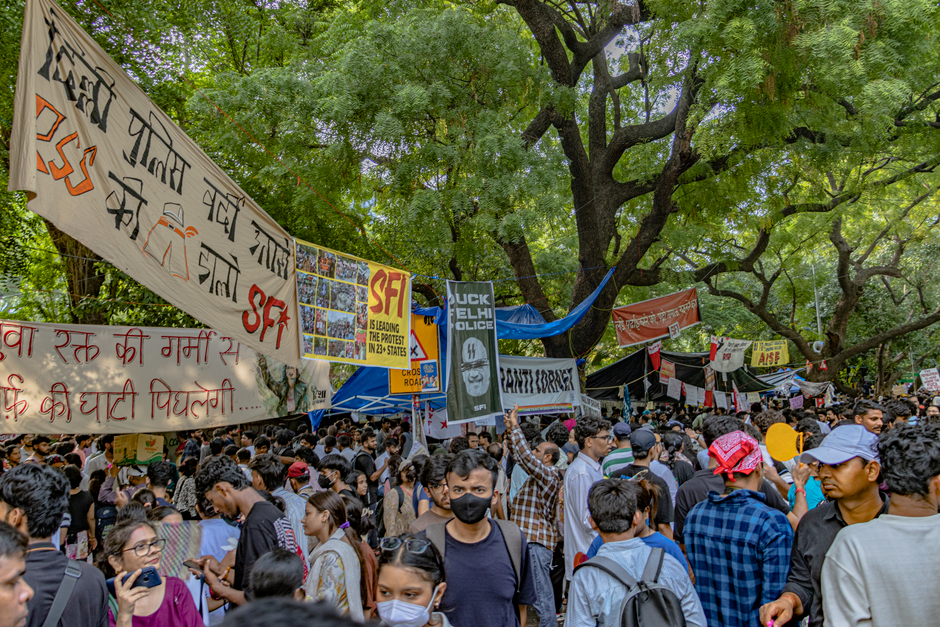
On the night of August 4, Prime Minister Narendra Modi’s Bharatiya Janata Party (BJP) suffered a stunning political setback – one of its most significant in 12 years. The event unfolded amidst a counting hall in Patna, where the nascent Jan Suraaj Party, led by political strategist Prashant Kishor, effectively dismantled the BJP’s stronghold over the bankipur constituency, a key location in Bihar’s legislative assembly. The defeat came less than two weeks after India’s Education Minister Dharmendra Pradhan resigned, bowing to seven weeks of student-led protests that had spread across several cities, largely fueled by the satirical social media campaign ‘Cockroach Janta Party’ (CJP). The CJP, born on Instagram in May, initially mocked the country’s unemployed young Indians with comparisons to ‘cockroaches’ and ‘parasites’, sparking widespread outrage and protests. The BJP, under Nitin Nabin, had spent the Bankipur campaign denouncing Gen Z protesters as ‘a virus and a parasite’, a stance that intensified the student protests. Instead of bolstering the BJP’s dominance, the CJP’s unexpected electoral victory has placed India squarely in a position where the party’s political machine – the BJP – is facing a significant reckoning. Analysts are questioning whether the BJP will be forced to fundamentally change its approach to dissent. The sheer awkwardness of the party’s response to the protests is particularly noteworthy. During the peak of the movement, Modi released a string of selfie-style videos on Instagram addressing exam paper leaks, urging ministers to engage with Gen Z on social media platforms, rather than traditional media briefings. The episode has also punctured a long-held BJP narrative: that Modi possesses a natural command over youth. Verniers, a researcher at the Center for International Studies (CERI), suggest the movement has shifted the focus from a simple political challenge to a broader issue of challenges to the BJP’s usual playbook against dissent – specifically, branding protesters as antinational, foreign-funded, or terrorists, mirroring the controversial Citizenship Amendment Act (CAA) of 2019. The CAA, which introduced a religious test for naturalized citizenship, further contributed to the movement’s anti-establishment sentiment. The movement could not be pinned to a single religion or community, and also drew in young people from the BJP’s own ‘upper-caste’ Hindu base, mirroring the success of the Aam Aadmi Party (AAP). Verniers argues that the Bankipur vote was strategically smart, offering restraint from the CJP so far. For the first time, the political committee on information technology demanded an apology from Meta chief executive Mark Zuckerberg. The BJP lost two by-elections in Uttar Pradesh, India’s most populous state, in states it governs, but comfortably retained the third, Manjalpur in Gujarat. Opposition leaders have drawn a direct line between the losses and the student protests, but analysts are more cautious. Ali warned against reading too much into the Bankipur vote. Verniers pointed to Haryana, where the BJP won a majority a few years after the northern state’s farmers joined a yearlong movement to oppose three agricultural laws. It was an election fought ‘not on farmers, but on caste’, he said. Verniers suggested that what had shifted was not the vote count but the strategic effectiveness of the BJP. The BJP, once perceived as a deeply decentralized space that rewards top-down discipline, has now proven remarkably resilient to setbacks. Verniers pointed to the Aam Aadmi Party (AAP) as an example – a movement that built a successful party but, a decade into power, is seen as a disappointment and on the verge of disappearance. Anjali, a postgraduate student and secretary of the All India Students’ Association (AISA), read the protests as the surfacing of a longer-term anger. The group, which mobilised alongside the CJP, planned to keep building the argument against the government on campuses nationwide. Ali warned against expecting the CJP to trade its Hindu majoritarian politics – an ideology known as Hindutva – for one built on jobs and education, as demanded by the Gen Z protesters. Verniers suggested that a leap into electoral politics is unlikely for the BJP, because the party’s authority is harder to repair with a by-election win. Verniers also suggested that the gap between the actual power that the BJP has, and its ability to have citizens comply and obey, is harder to repair. Anjali said AISA’s posture in similar terms: present at Jantar Mantar, but unwilling to let the fight narrow to one resignation. The group, she said, plans to keep building the argument against the government on campuses nationwide. Al Jazeera reached out to 18 BJP national spokespeople for their responses to this article, but did not receive any replies. Ali said he did not expect the BJP to trade its Hindu majoritarian politics – an ideology known as Hindutva – for one built on jobs and education, as demanded by the Gen Z protesters. “I don’t think the BJP would dilute its Hindutva agenda; if anything, it would double down on it, so that the most salient issue in any election is religious identity,” he said. He cited the party’s ability to win elections, engineer defections, and outspend rivals, as proof of their continued success and of the BJP having pushedONE of the boundaries of what is democratically admissible. But the authority behind that dominance is what the protests have dented. Verniers suggested that the gap between the actual power that the BJP has, and its ability to have citizens comply and obey, is harder to repair. Anjali described AISA’s posture in similar terms: present at Jantar Mantar, but unwilling to let the fight narrow to one resignation. The group, she said, plans to keep building the argument against the government on campuses nationwide. Al Jazeera reached out to 18 BJP national spokespeople for their responses to this article, but did not receive any replies. The political fallout from the Bankipur victory is substantial, potentially reshaping the BJP’s strategy and its relationship with Gen Z.
Source: Al Jazeera