






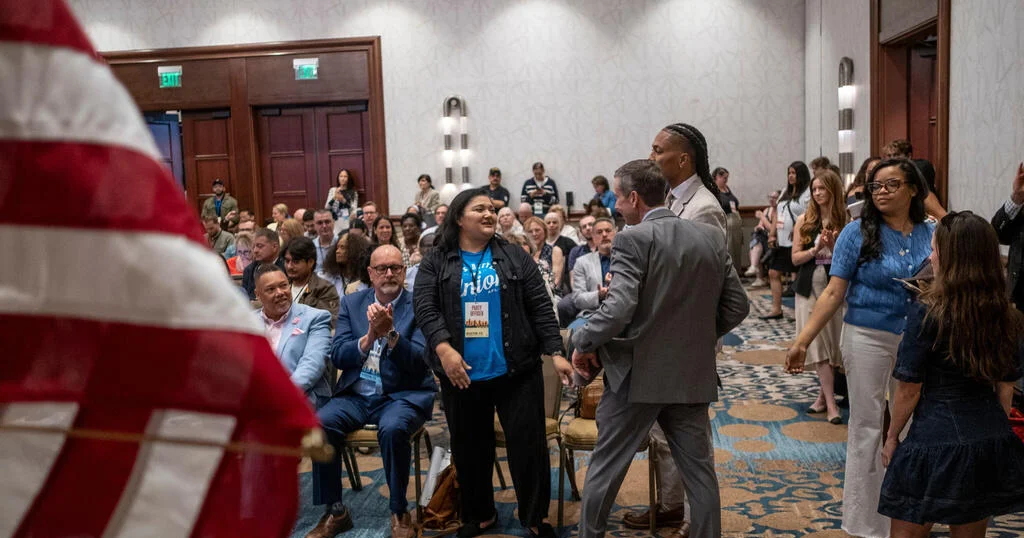
The Democratic National Committee (DNC) has approved a new presidential nominating calendar for 2028, marking South Carolina as the inaugural state to host a Democratic primary race. This significant move reflects a broader effort by the party to elevate states that better reflect its diverse coalition of voters, a strategic shift aimed at bolstering momentum within the Democratic electorate.
The vote, during the DNC’s summer meeting in Austin, Texas, saw members of the Democratic National Committee sign off on a schedule beginning with South Carolina on January 22nd, followed by Nevada on February 1st. New Hampshire, New Mexico, Michigan, and Virginia will then continue the early-state lineup throughout February, all voting before Super Tuesday.
The new calendar’s implementation is driven by a complex interplay of factors, notably a contentious internal debate within the progressive and establishment wings of the party. It also represents a significant departure from a tradition that for half a century, afforded to states predominantly composed of White voters, like Iowa and New Hampshire, disproportionate influence at the start of the nomination process. Strategists emphasize that the new calendar grants greater influence to Black and Latino voters, who are pivotal components of the Democratic coalition.
This shift is particularly significant given the DNC’s recent push to bolster support among these key demographics, particularly in Michigan and Virginia, where historically, more moderate candidates have been favored. However, not all Democrats are on board with the new map, with Iowa and New Hampshire officials issuing strong criticism, arguing that it diminishes the role of states that have long championed the shaping of the presidential nomination battle.
Specifically, Democratic leaders in Iowa and New Hampshire have expressed outrage at the new schedule, characterizing it as a diminishing of the influence of states that have long taken on the responsibility of shaping the presidential nomination battlefield. New Hampshire’s First in the Nation primary is a crucial proving ground for the party, demonstrating that candidates are being thoroughly vetted and that the state’s voters are putting candidates through their paces. The DNC’s Rules and Bylaws Committee recommended the change as part of a broader effort to shift the balance of power within the Democratic party.
Initial momentum for South Carolina’s ascension in the calendar is rooted in 2020, when a victory there shifted momentum in the presidential primary that year to Joe Biden after he performed poorly in Iowa, New Hampshire, and, to a lesser extent, Nevada. Under pressure from Biden and his allies, the DNC moved South Carolina’s primary to first for the 2024 calendar. The DNC has signaled that if New Hampshire jumps ahead again in 2028, punishment will be more severe.
This new calendar could significantly impact the ideological battle within the Democratic Party, particularly between moderates and more progressive factions, including far-left democratic socialists. Given the absence of a clear 2028 front-runner, the newly approved schedule gives South Carolina, Nevada, and the other four early states disproportionate influence over which faction can build early momentum in the 2028 presidential primaries. Among the states granted early slots, only Nevada and New Mexico offer clear advantages to progressives.
Progressives face an uphill battle in South Carolina, which has fewer of the White voters with college degrees who tend to support further-left candidates, and Virginia, which has long favored more moderate candidates. The decision to elevate states with large Black and Hispanic populations also comes as Democrats fight to stop the GOP from gaining ground with those two groups in general elections. President Trump won 48% of the Hispanic vote in 2024, up 12 points from four years earlier, and he won 15% of Black voters, almost double his share in 2020, according to the Pew Research Center. His share of non-Hispanic White voters remained stable, at 55%.
Watch Related Video
Source: CBS News