






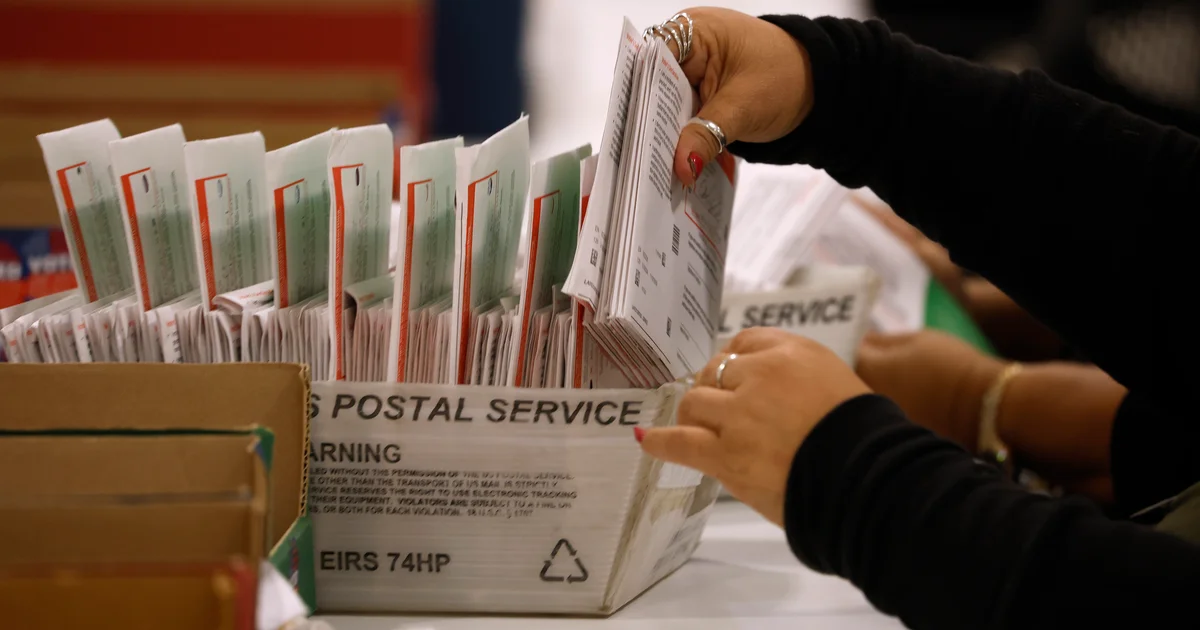
A federal appeals court effectively denied the Trump administration’s request to halt a lower court’s order blocking new rules for mail ballots before the midterms, the latest development in a case already heading to the Supreme Court.
The court, comprised of three judges – Gustavo A. Gelpí, Julie Rikelman, and Seth Aframe – found the administration’s request to be unsupported by legal grounds, asserting that the new rules from the USPS would inevitably lead to widespread voter disenfranchisement, particularly in the November midterms. The court’s opinion, released Thursday, detailed the reasoning behind its decision.
The appellate panel, interpreting the lower court’s ruling, stated that implementing the new rule would likely result in millions of voters being disenfranchised, with minimal gains in combating voter fraud. The judges emphasized that the district court correctly determined that the Final Rule is a regulation of election administration, not an executive agency action, and that the Elections Clause of the Constitution applies solely to states and Congress, not executive agencies.
The ruling, issued by Judge Talwani, found that the USPS’s requirements for mail ballot design are likely unconstitutional and that states are struggling to implement the regulations, which are nearly upon the November election, ‘nearly guarantee’ significant voter disenfranchisement. The USPS’s rules mandate state and local election officials to meet design requirements for mail ballots, including unique barcodes, and require online submission of voter information, such as names, addresses and individualized barcodes.
In response to the court’s decision, the Trump administration filed a petition with the Supreme Court, arguing that the Talwani injunction is ‘baseless’ and that the Postal Service has the authority to regulate these aspects of mail ballot design. Solicitor General D. John Sauer submitted a brief arguing for a stay of the injunction, asserting that the new rule is a lawful exercise of the USPS’s express statutory authority.
The case has already reached the Supreme Court, and the court is expected to rule on the administration’s request before the final rule goes into effect. The legal battle underscores the ongoing tension between executive agencies and state and local officials regarding election administration, and the potential implications for the November midterms.
Watch Related Video
Source: CBS News