





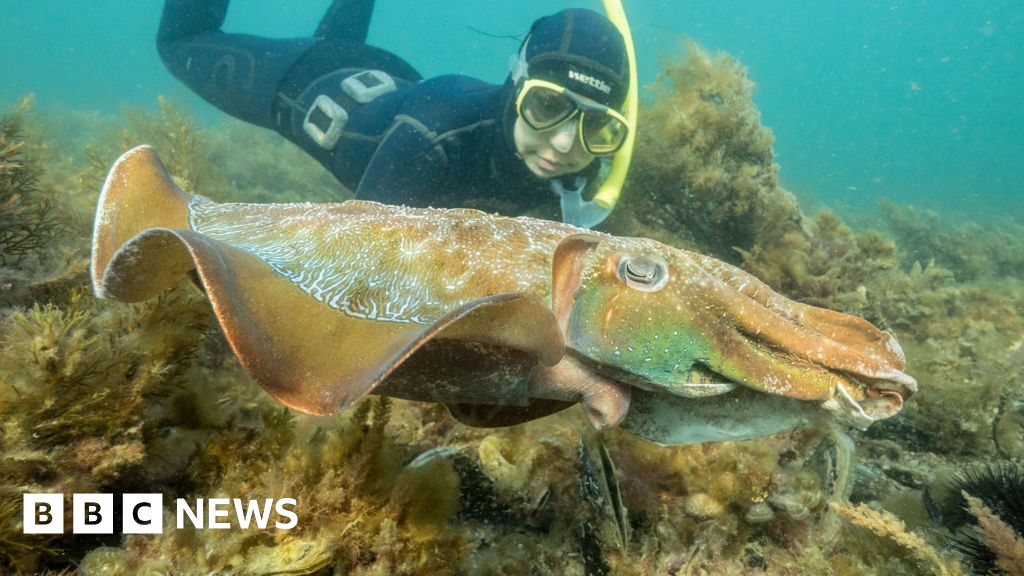
Every winter, a significant portion of the South Australian coastline hosts the world’s largest mating event for giant cuttlefish, a phenomenon that has been steadily diminishing over the past several years. The annual event, known as the Cuttlefish Coast mating season, draws thousands of divers and researchers to observe the unique marine species endemic to Australia. Traditionally, hundreds of thousands of cuttlefish gather along the Cuttlefish Coast, creating a breathtaking spectacle of color and shape-shifting figures. However, this year’s turnout has been the lowest on record, prompting serious concerns about a potential catastrophic decline in the species’ population.
Official figures released this month estimate just 1,811 cuttlefish turned up to mate this year, down from a peak of 63,000 last year – a staggering 97% drop. The state government has stated that a toxic algal bloom, rapidly expanding across the coastline for over 18 months, is believed to be a primary driver of this decline. The bloom, driven by ocean warming and nutrient pollution, is severely impacting the delicate marine ecosystem. The low numbers have also prompted calls for the species to be formally listed as endangered, highlighting the vulnerability of this unique population.
The low figures have also prompted urgent calls for the government to consider taking action. Adult cuttlefish typically die after breeding, meaning each mating season is crucial for the species’ future, but recent months have seen just 440 eggs counted, instead of the millions that are usually laid. Manny Katz, 28, a diver who spent hours along the coast last month to observe the breeding event, said, “Because there have been so few cuttlefish, DEW thought it would be worth going out and trying to do an assessment of how many eggs there currently are around the coastline to understand what the population is going to be next year.” His team did eight one-hour dives, exploring the undersides of rocky reefs to count the eggs. [We] pretty much looked under every single rock that we could have and we only found about 440 eggs.
The adult cuttlefish only live about 12 to 18 months, Katz said, “so the success of one breeding season is going to determine the population next year,” “Under our current circumstances, with there being so few eggs along the coastline, we don’t know if the population is ever going to be able to recover,” he added. While it’s too early to tell what this means for the species’ future, Katz said: “we will know that answer probably in the next year or two, whether or not this year has been a catastrophic decline.” His team also tracked adult cuttlefish numbers during the dive survey, and said the dozen or so they saw – when there should have been tens of thousands – appeared to be behaving differently. [This year, they were all really skittish… hiding under rocks. Because there’s so few cuttlefish hanging out at the moment, they don’t have strength in numbers.] Katz said he wasn’t shocked by the low numbers this winter given the devastating impact of the algal bloom in South Australia since it was first detected in March last year. The algal bloom – a rapid increase in the population of algae in water systems – is naturally occurring but is caused by ocean warming, marine heatwaves, and nutrient pollution – all exacerbated by climate change.
The algal bloom – a rapid increase in the population of algae in water systems – is naturally occurring but is caused by ocean warming, marine heatwaves, and nutrient pollution – all exacerbated by climate change – is a leading plausible explanation and appears likely to have contributed, but the available evidence does not yet allow us to say definitively that it caused the entire decline.
Last year’s cuttlefish mating season was not impacted as the effects of the algal bloom had not yet reached the Cuttlefish Coast, Katz said, but since late last year, small concentrations of the toxic algae have been detected in the area. This was particularly worrying as cuttlefish, along with other cephalopods like octopus and squid, are particularly vulnerable to the toxic algae.
Stefan Andrews, co-founder of the Great Southern Reef Foundation, is seeking to have the giant Australian cuttlefish listed as a threatened species given its “catastrophic decline” due to the algal bloom and the impact on the next generation. He said with so few adults and so little breeding activity observed, the number of young entering the population is likely to be very low.
He said with so few adults and so little breeding activity observed, the number of young entering the population is likely to be very low, but he remained hopeful as “we know from the past that this population has the capacity to recover when conditions are favourable.” He said there were “positive signs” as adult cuttlefish were continuing to lay eggs and the population may recover “over coming years”.
Watch Related Video
Source: BBC News