





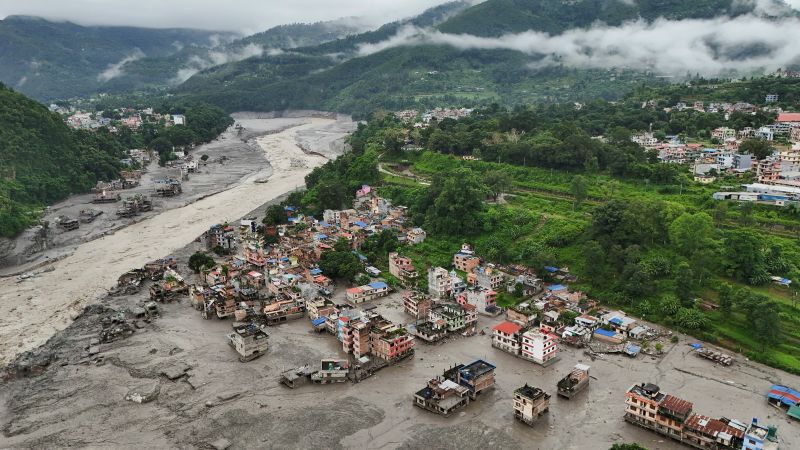
Deadly flooding along the China-Nepal border has intensified scrutiny of the Himalayas’ growing risks from natural disasters, alongside a rapid surge in infrastructure development by countries in the region.
There’s no evidence to suggest that the latest disaster, which has killed more than 600 people and left 2,500 missing on both sides of the border, was linked to man-made development.
However, the devastation could be a stark reminder for governments grappling with a boom in dams, tunnels, highways, railways, and bridges across the Himalayas, aiming to harness the region’s vast hydropower potential and resources – and fortify their borders there.
No country has marshaled those efforts like China, where the government sees Tibet, and its Himalayan borderlands, as critical to its national and energy security.
Beijing aims to transform the region into a high-altitude, green-energy powerhouse, with projects that include a $168 billion megadam, currently under construction, that could stretch the limits of what human engineering has achieved.
It’s not just China. India, and to a lesser extent Nepal, have been on an infrastructure-building spree in recent years, funneling hundreds of millions of dollars into developments in a part of the world that is acutely vulnerable to earthquakes, natural hazards, and climate change.
On Wednesday, a meeting of China’s ruling Communist Party elite led by Xi Jinping emphasized the “enormous challenges to rescue and emergency response efforts” due to ‘numerous glaciers, glacial lakes, and potential geological hazards,’ and variable weather.
Despite these signals, whether or not the catastrophe becomes a wake-up call for Himalayan nations with big infrastructure dreams remains an open question. Experts say the severity of the event and its positioning on an international border should make state planners think more carefully about how they design, situate and scale projects in the region – and spark regional discussion about shared risk monitoring systems.
That’s especially as climate change makes natural disasters more extreme and less predictable.
‘We’re getting ‘100 year floods’ every five to ten years… the climate risks are evolving faster than our than our ability to shift the margins on what we think are the horizons of safety,’ said Austin Lord, a senior fellow in the Energy, Water, and Sustainability Program at the Stimson Center think tank in Washington.
With so many unknowns, if we don’t start working on them together then we won’t make any progress, and we’ll just be overwhelmed again next time,” he said.
The Himalayan landmass rises from shifting fault lines and is sliced by mighty rivers that are fed by glaciers. Millions of people across the floodplains of the Indian subcontinent depend on the water the flows downstream.
It’s one of the most ecologically and seismically sensitive regions in the world, but the potential to tame its rivers into major hydropower projects has long enticed engineers.
Chinese engineers are widely seen as among the best in the world, making advanced efforts to incorporate mitigation features and surveillance.
But even still, experts say the realities of construction – ‘blasting through rock with dynamite, pouring concrete into natural landforms, and storing water in reservoirs’ – could have unintended effects.
Landslides, debris flows, and glacial lake outburst floods are all features of the area that are becoming more unpredictable with climate change.
This week, Nepal saw more than 430 megawatts of power – enough to power hundreds of thousands of homes – – knocked offline after 12 dams were hit by the surge of floodwaters. There was also damage to other under-construction projects, estimated to account for another 470 megawatts of capacity, according to Nepal’s Ministry for Energy, Water Resources and Irrigation.
China has faced past criticism for not sharing data and design information with India on its Yarlung Tsangpo megadam project. It’s also widely understood to have suspended water flow data on transboundary rivers for a period of time in the wake of a 2017 border standoff.
During regular border talks in Beijing on Tuesday, Chinese and Indian officials pledged to maintain communication on hydrological data sharing and said they would hold the next of their roughly biennial meetings on trans-boundary rivers next month.
China’s Embassy in Nepal responded with a post on X calling the accusations, and others that it didn’t send out warnings early enough, “fake news.”
“Accusation helps nothing… cooperation save lives,” the post said.
China’s leader Xi on Friday said in a message to Nepali President Ram Chandra Poudel that his country was ready to “actively assist Nepal in its rescue efforts.”
The two sides were also in touch on monitoring a barrier lake that risks flooding and imperiling rescue workers.
Nepal does not have direct access to the area to conduct its own real-time monitoring, but updates were being passed between authorities on both sides as well as between researchers, CNN reported earlier.”
Watch Related Video
Source: CNN