





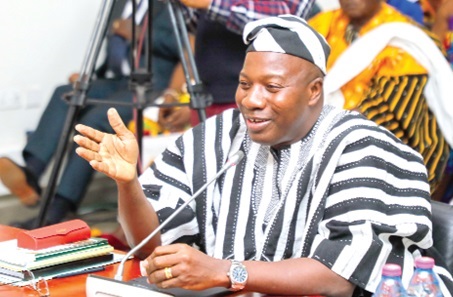
The Minister Designated for Local Government, Chieftaincy and Religious Affairs, Chieftainya Ayariga, has announced a significant initiative to bolster local revenue generation through the establishment of a technology-driven system for property assessment and collection within Metropolitan, Municipal, and District Assemblies (MMDAs). He stated that this initiative has the potential to yield an estimated GH¢20 billion annually, describing the assemblies as a crucial engine for local economic development.
Mr. Ayariga, responding to questions from Parliament’s Appointments Committee during his vetting yesterday, highlighted the vision of the 1992 Constitution, which envisioned assemblies as largely self-financing entities, primarily focused on development. However, he acknowledged a historical failure to fully exploit the revenue potential inherent within these structures. The current system relies on property rates, basic rates, market tolls, and lorry park fees as primary revenue sources.
He explained that the initiative will commence with the establishment of an infrastructure to comprehensively identify all properties across the country. Currently, existing street naming and property addressing systems only focused on identified properties, failing to provide information on property value for taxation purposes. The proposed nationwide exercise aims to meticulously identify, describe, and value properties to facilitate the levy of appropriate rates.
According to Mr. Ayariga, the initial stage of implementation would involve establishing a robust system for identifying and documenting all properties. He further explained that the existing street naming and property addressing system only located properties, but did not provide information on their nature or value for taxation purposes. The Local Government Minister designate stressed that the MP’s role was solely to direct which project to undertake, not to allocate the funds to the MP.
When asked about the utilization of the DACF and the role of MPs, Mr. Ayariga asserted that MPs were not entitled to the entire Common Fund of an assembly. He emphasized that the use of the DACF was guided by ministry guidelines and decisions of the respective assemblies, meticulously considering location, execution, and project priorities. Parliament allocated a small amount within the formula for MPs to identify priority projects in their constituencies. The Bawku Central lawmaker pointed out that the money remained in the assembly’s account, with MPs only directing which projects should be undertaken, including emergencies such as storm-damaged schools or shortages of basic amenities at health facilities. The assembly handled procurement, engaged contractors, and made payments upon completion and certification.
Furthermore, he proposed greater investment in the Environmental Protection Authority (EPA) and the Minerals Commission, including the recruitment of more district-level mining engineers, to monitor operations, enforce environmental standards, and ensure land reclamation. He questioned the location of the previous project, highlighting its poorly executed nature and the need for greater private and philanthropic funding to revitalize and complete the project.
Mr. Ayariga expressed a commitment to supporting efforts to revive and complete the project, acknowledging the need to balance local participation with the President’s executive authority. He stated that the Minister’s role was to support traditional institutions with resources and facilitation, while disputes remained the preserve of the Houses of Chiefs and the Supreme Court. The Minister pledged a listening and conciliatory approach to chieftaincy affairs, stressing that ministers had no constitutional mandate to interfere in chieftaincy disputes. The role of the Minister, Mr. Ayariga stated, was to support traditional institutions with resources and facilitation, while disputes remain the preserve of the Houses of Chiefs and the Supreme Court.
Watch Related Video
Source: Graphic Online