





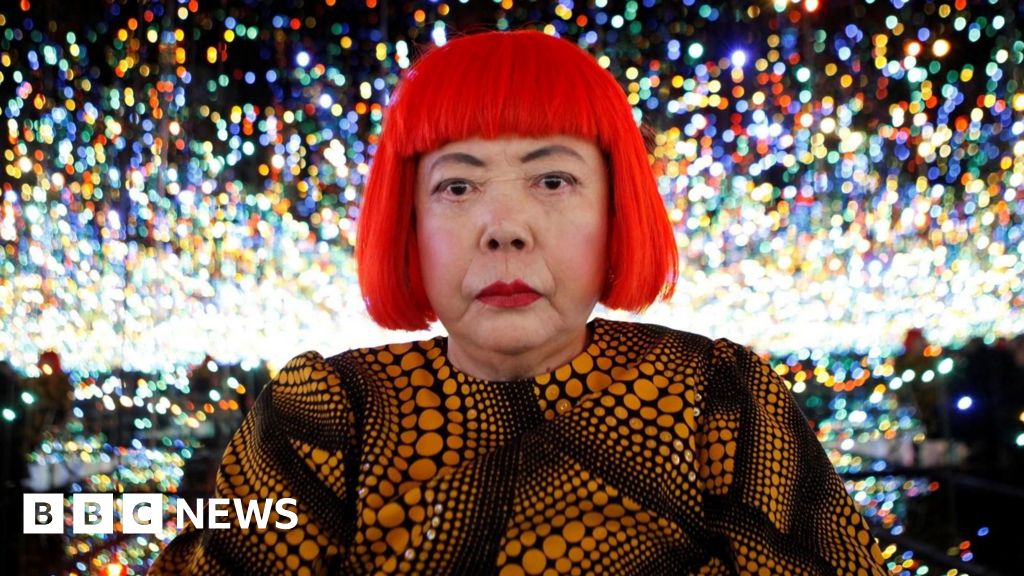
The art world is reeling today following the announcement of Yayoi Kusama’s death at the remarkable age of 97, a figure who indelibly shaped the landscape of modern and contemporary art. The Japanese avant-garde artist, renowned for her intensely personal and immersive installations, has passed away at the Tokyo hospital where she was receiving treatment. The news, confirmed by Kusama’s own company, marks a significant loss for the global artistic community and a poignant moment for those who knew her extraordinary life and work. Her death is a testament to a lifetime dedicated to artistic exploration, a lifetime defined by a singular, almost obsessive preoccupation with infinity and self-reflection. Kusama’s legacy extends far beyond her iconic polka-dot ensembles and swirling, immersive sculptures; it’s a complex and deeply psychological narrative woven into a vast and ever-evolving artistic vocabulary. Born in 1929 in the rural Japanese countryside, Kusama’s early artistic journey was largely self-directed, fueled by a burgeoning fascination with the surreal and the mathematically precise. It was this inherent fascination that would become the core of her unique artistic voice. Her early work, often characterized by small, meticulously rendered dots, foreshadowed the monumental scale and psychological depth that would characterize her later explorations. Initially, Kusama’s artistic pursuits were rooted in a desire to create a ‘mirror’ – a visual representation of the self, mirroring the complexities of her own mind. This initial focus on the reflection, however, would evolve into a profoundly personal and intensely psychological exploration of the human condition.
Throughout her prolific career, Kusama consistently pushed the boundaries of artistic convention. She embraced abstraction, creating vast, immersive installations that envelop viewers, demanding active participation and a profound engagement with the artwork. Her ‘Infinity Nets,’ for example, are massive, sculptural structures that visually represent the infinite repetition of polka dots – a motif that has become inextricably linked with her identity and artistic philosophy. These installations weren’t simply about visual spectacle; they were designed to induce a state of meditative absorption, prompting viewers to confront their own anxieties and desires. Kusama’s work has been lauded for its ability to evoke intense emotional responses, often triggering feelings of disorientation, anxiety, and a strange sense of homecoming. She often described her work as an attempt to ‘see the world as it is, not as it appears.’
Her artistic process was notoriously idiosyncratic and demanding, frequently involving lengthy periods of solitary work and a near-constant need for stimulation. She lived and worked primarily in a pyschiatric hospital, a decision that became a defining element of her artistic practice, reflecting a deep-seated preoccupation with mental health and the potential for artistic expression to offer solace and understanding. The hospital environment, with its enclosed spaces and carefully controlled conditions, became a crucible for her creative process. She meticulously crafted her environment, using mirrors, lighting, and a carefully curated palette to create a space that reflected and amplified her own internal world. The hospital’s isolation further contributed to her artistic focus, fostering a sense of detachment from the outside world and a heightened awareness of her own psychological state. Kusama’s artistic output has been consistently analyzed and interpreted through the lens of psychoanalysis, with many scholars focusing on her use of symbolism, repetition, and the manipulation of perspective to generate a sense of unease and disorientation. Her work frequently draws on themes of isolation, mortality, and the subconscious – exploring the anxieties and uncertainties that often lurk beneath the surface of the conscious mind. The ‘House of Mirrors’ installations, in particular, are renowned for their layered complexity and their ability to create a disorienting and unsettling experience for the viewer. She consistently employed unconventional materials, like mirrored tiles and reflective surfaces, to create a visual landscape that constantly shifted and changed, mirroring the fluidity of perception.
Beyond the visual spectacle, Kusama’s art is deeply intertwined with performance art and poetry. She frequently collaborated with other artists, creating immersive performances that blended visual art with music, movement, and text. Her work often explores themes of mortality and the fleeting nature of time, reflecting her own preoccupation with aging and the passage of years. She frequently incorporated elements of Japanese aesthetics, particularly the concept of ‘yin and yang,’ into her work, creating a visual representation of the interplay between opposing forces. The ‘Infinity Rooms’ are a prime example of this, constructed to appear to endlessly repeat, creating a visual paradox that embodies the infinite and the cyclical.
Kusama’s influence on contemporary art is undeniable. Her innovative use of repetition, distortion, and scale has inspired generations of artists, from Marina Abramović to Jeff Koons. Her work has also been increasingly embraced by the digital realm, with artists utilizing her imagery and aesthetics in virtual reality and interactive installations. Despite her immense artistic output, Kusama remained remarkably private about her personal life, often shielding her from public scrutiny. She maintained a carefully curated image of herself, a carefully constructed persona that emphasized her artistic vision and her unique approach to self-representation. The loss of this singular, enigmatic figure leaves a void in the art world, but her legacy as a visionary and a master of immersive experience will undoubtedly endure for generations to come. The sheer scale and complexity of her creations continue to inspire awe and provoke deep contemplation. Her dedication to pushing the boundaries of artistic expression, coupled with her profound exploration of the human psyche, solidifies her position as one of the most important and influential artists of the 20th and 21st centuries.
Watch Related Video
Source: BBC News