





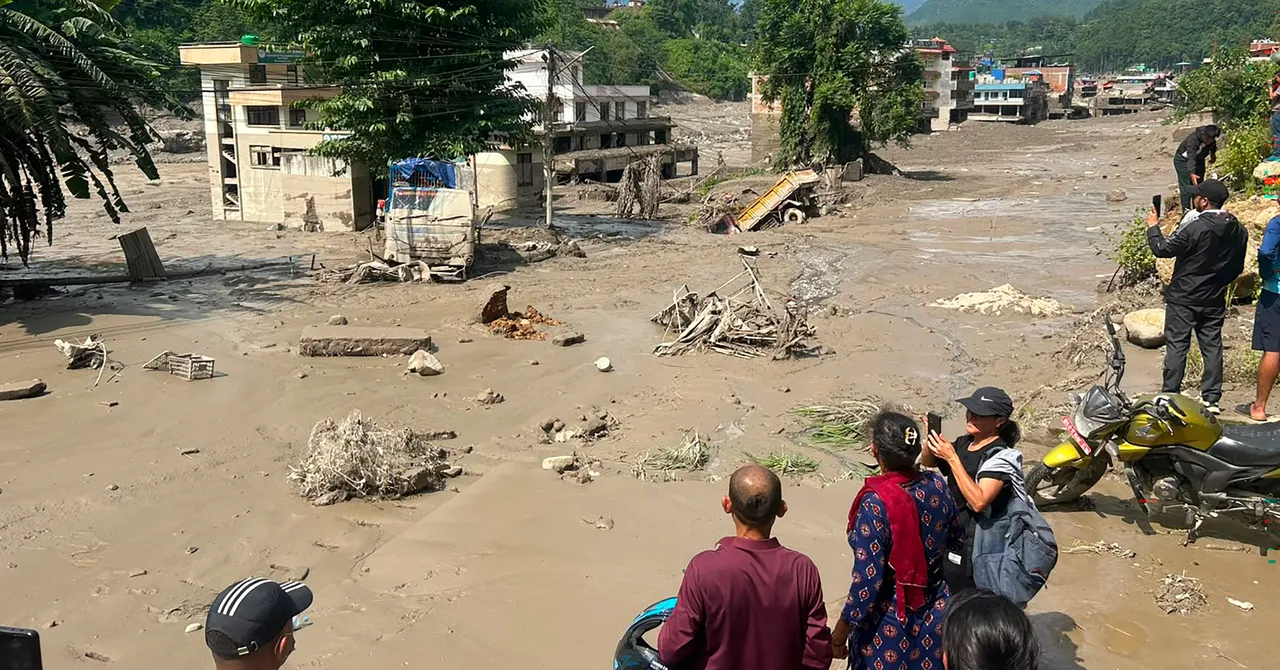
Wednesday witnessed a devastating flash flood sweep across Nepal and Tibet, claiming the lives of approximately 160 people and leaving hundreds more missing, highlighting a growing crisis fueled by climate change. The disaster, which began with a landslide triggered by a glacial collapse, has rapidly escalated into a massive humanitarian crisis, exposing vulnerabilities across the region and raising serious concerns about global stability. Initial investigations point to a confluence of factors, most prominently a rapidly retreating ice mass, as the primary driver of the catastrophic flooding.
Analysis of satellite imagery and data from the Nepalese government reveals that the floods were likely initiated by a landslide resulting from the collapse of a substantial portion of a glacier, a process exacerbated by an ongoing warming trend. As the region experiences a sustained increase in temperatures, the ice mass is destabilizing at an alarming rate. The Nepalese government estimates that over 5 percent of the world’s glaciers have already lost ice, with significantly more drastic impacts observed in certain regions. Nepal’s glaciers, encompassing nearly a quarter of its total area, have lost nearly a quarter of their ice between 1970 and 2010. Research conducted by Professor Joseph Shea, an associate professor of geography at the University of Northern British Columbia, confirms that glacial mass loss is accelerating, with estimates suggesting that as much as 40 percent of the world’s glacial ice could disappear within the next 1.5 degrees Celsius of warming under current trends.
This alarming projection is further substantiated by a recent study by Dr. Daniel Shugar, a geologist at the University of Calgary, which analyzed satellite imagery. Shugar noted that the observation of a 2,000-foot wide piece of ice falling almost 4,000 feet, pulverizing it into water, suggests a dramatic and rapid disintegration of the ice. While Shugar emphasized the need for further investigation, he did note that snowmelt, occurring earlier in the week, may have been exacerbated by rising temperatures, contributing to the increased instability.
The consequences of these glacial shifts are profound. As glaciers retreat, they trigger landslides, significantly increasing sediment loads in valleys, and can lead to the damming of lakes, creating overtopping events that can cause catastrophic collapse. The collapse of a Swiss glacier last year, buried a town, and killed 11 mountaineers, demonstrates the potential for such events to cause widespread devastation. The recent flooding is more likely linked to a glacial collapse that fell into the valley below, as evidenced by the US Geological Survey’s seismic event registration.
Furthermore, the warming trend is creating a complex feedback loop. Shea stresses that retreating glaciers can trigger landslides, and as glaciers retreat, they leave behind large, dammed lakes at higher elevations. These lakes can then become susceptible to catastrophic collapses, potentially leading to widespread inundation and loss of life. The warming of the planet is creating a cascade of destabilizing factors, including alpine permafrost thaw, which warms the ground and causes large blocks and chunks to become mobile. The study by Shugar highlights the urgent need to mitigate the impacts of climate change globally. The combination of increased temperatures, increased melt rates, and altered hydrological processes presents a serious threat to vulnerable communities across Nepal and beyond, underscoring the critical importance of immediate and sustained action to address this escalating crisis.”
The situation is further complicated by the interconnectedness of these processes, suggesting that the effects of warming are amplified by the synergistic interactions between these factors. The situation is particularly dire for communities dependent on glacial resources, highlighting the urgent need for adaptation and mitigation strategies to protect lives and livelihoods. The disaster serves as a stark reminder of the escalating risks posed by a rapidly changing climate, demanding a global commitment to reducing greenhouse gas emissions and transitioning to a sustainable future.”
Watch Related Video
Source: Wired Science