





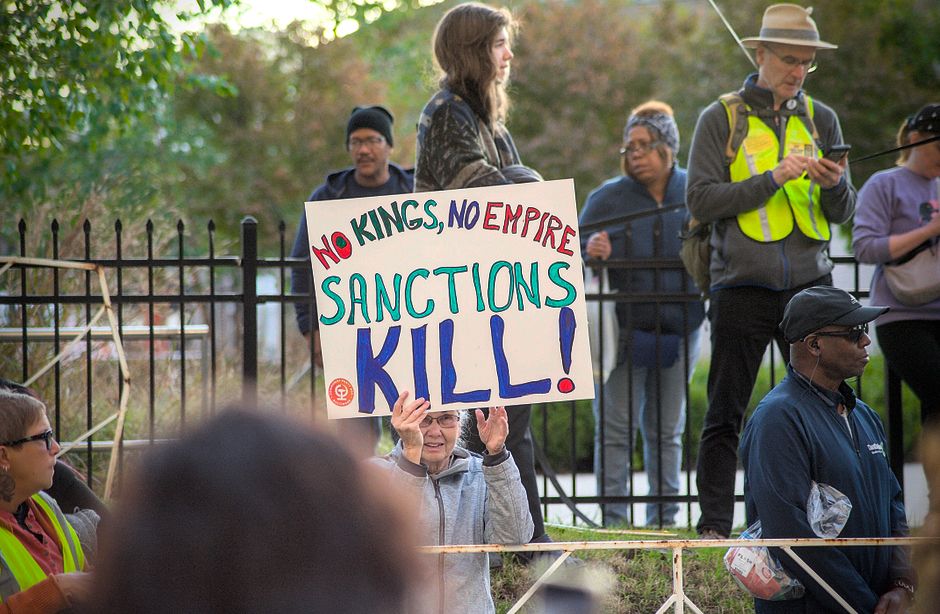
The United States is intensifying its economic pressure on Iran, signaling a dramatic escalation of tensions following a stalled diplomatic effort to end the war on the nation. With President Donald Trump’s repeated threat of punishing any country engaging in business with Tehran, the US Treasury Department has announced a new series of unprecedented measures designed to cripple the Iranian government’s financial infrastructure.
Following a recent announcement on Saturday, Iranian officials threatened to retaliate against any country that participates in US sanctions against it, further escalating the situation. This follows weeks of escalating economic measures, including a naval blockade on Iranian ports, targeting companies, brokers, and tankers involved in the export of Iran’s oil. The US is also imposing sweeping sanctions on Iran’s oil, shipping, and financial sectors, aiming to cut off its revenue stream from energy exports.
On Wednesday, Trump announced what he called the ‘most crushing economic operation’ against Iran, stating that Iran had ‘failed to take’ the opportunity to make a deal and would face ‘economic warfare and isolation on an unprecedented scale.’ He explicitly threatened sanctions against any country that engages in trade with Iran, labeling it a ‘complete erosion of sovereignty.’
The Trump administration has already been waging an economic pressure campaign against Iran under the ‘Operation Economic Fury’ initiative since the launch of the war in February. This campaign has included a naval blockade on Iranian ports, disrupting oil exports, and targeting companies, brokers, and tankers associated with Iran’s oil trade.
The US strategy now centers on intensifying sanctions, not just targeting Iran’s oil exports but also its financial sector, aiming to destabilize the regime. The US is also considering a comprehensive embargo on Iran’s financial institutions, businesses, airports, and government entities, effectively cutting off Iranian access to international capital.
In a Truth Social post, Trump warned that any country that allows its financial institutions, businesses, airports, or government entities to provide any type of lifeline to Iran will face ‘TREMENDOUS Economic Consequences.’ He also threatened sanctions against any country that continues to trade with Iran, emphasizing that the US Treasury and the US government would impose ‘forceful’ enforcement against those who continue to trade with Iran.
This strategy is designed to exert maximum pressure on Iran, aiming to weaken the regime and potentially trigger a collapse of the government. The US is also seeking to limit Russia and China’s ability to support Iran, both of whom are major trading partners and are seen as potentially aiding the regime.
Experts suggest that the US is attempting to establish deterrence at an earlier stage, with pre-emption, targeting the more hardline elements of the IRGC, and disproportionate retaliation, aiming to raise the cost of any attack that does occur.
China has pushed back against Trump’s threats, stating that imposing sanctions and pressuring do not help to solve the issue. They called on regional confidence in diplomacy to be strengthened, suggesting that Gulf states could join Washington in economically threatening Iran further.
While the US has made threats against any country that continues to trade with Iran, Trump’s leverage over China and Russia, both major trading partners of Iran, is limited.
Analysts suggest that China could hit back if the US sanctions the major Chinese banks for processing Iranian funds, as the US Treasury has threatened. The UAE, which is Iran’s neighbor and also US ally, has increasingly been finding itself caught in the middle of the war. Analysts say that Gulf countries can’t change geography. They have to live and work alongside Iran. The UAE has also provided Shahed drones to Moscow for use in its war on Ukraine, which could further complicate the situation.
The US is currently operating military facilities in more than a dozen locations across the region, including in Jordan. Paul Musgrave, a professor of government at Georgetown University in Qatar, said that it is going to be very difficult for Trump to pull off his pressure campaign effectively.
Musgrave warned that Trump’s strategy could be difficult to execute, and that Trump may be tempted to unilaterally assert the kind of coordinated sanctions that traditionally has taken multilateral coordination, and that means getting on board China, Russia, the P5 of the UNSC.
This is because several sectors in Russia and China have minimal reliance on the American financial system.
The US is also exploring the possibility of limiting Russia’s ability to support Iran, given that Moscow and Tehran have spent years developing critical commercial and military links designed to sidestep Western channels.
Analysts say China could also hit back if the US sanctions the major Chinese banks for processing Iranian funds, as the US Treasury has threatened. The US is also considering a comprehensive embargo on Iran’s financial institutions, businesses, airports, and government entities, effectively cutting off Iranian access to international capital.
This is a complex situation with significant implications for regional stability and global trade. The situation is evolving rapidly, and the potential consequences of any further escalation are substantial.
Source: Al Jazeera