





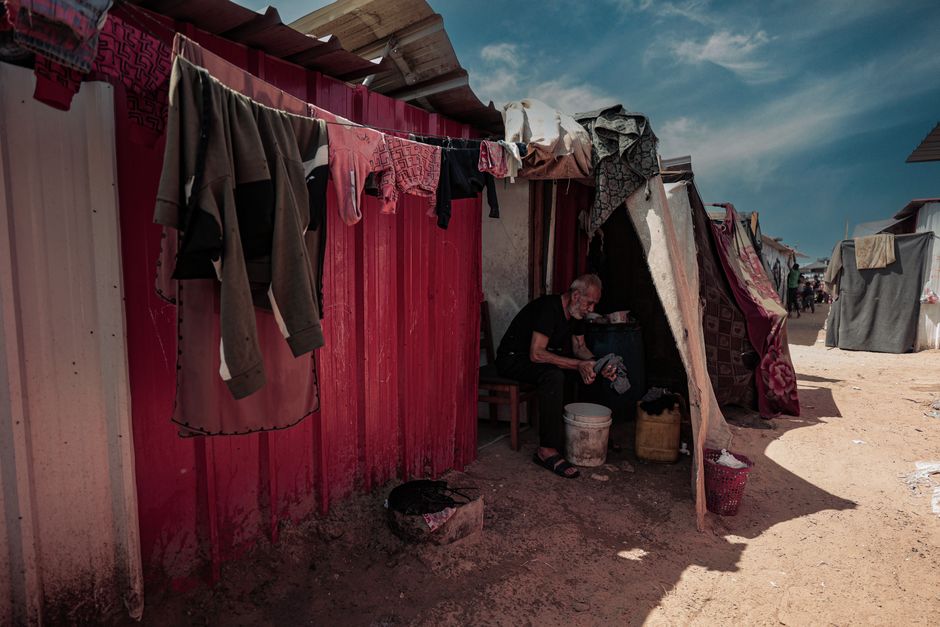
Gaza, a city scarred by Israel’s devastating war, continues to grapple with a dire humanitarian crisis, exacerbated by the ongoing siege and the desperate struggle for basic necessities. Eman Mahmoud Shamia, a 33-year-old mother, exemplifies this struggle, experiencing repeated displacement and limited access to essential sanitation facilities within her tented camp. Since October 2023, the situation has spiraled, with a significant increase in the number of displaced individuals and a critical shortage of safe, discreet, and sanitary toilets. The lack of adequate infrastructure is profoundly impacting the well-being of the affected population, forcing a profound reliance on rudimentary solutions.
It’s a stark reality that hundreds of thousands of Palestinians have been displaced, often overlooked amidst the broader devastation of the conflict. The community in the camp, comprising 33-year-old Eman, her husband Yahya Shamia, and their five children, is forced to endure a cycle of constant relocation and the struggle to maintain some semblance of dignity. The existing communal toilet system, a relic of a bygone era, is a glaring example of this deficiency.
With the aid of a specialized worker, tasked with digging soakaway underground drainage pits, the camp community built a ‘municipal toilet’. This primitive structure provides temporary relief, but Shamia emphasizes that it’s a far cry from the comfortable and private spaces afforded to her and her family. The lack of privacy is particularly acute for Eman, who is a woman and a mother, and for Yahya, who suffers from advanced lung cancer, limiting his ability to utilize the makeshift toilet.
The situation is further complicated by the escalating cost of sanitation supplies. According to Mohammad Al-Hanouti, a 30-year-old from Al-Bureij refugee camp, a small stall owner who lives in an unfinished apartment without plumbing, his earnings are often insufficient to cover the basic cost of a toilet seat, let alone a more substantial one. The price of used toilet seats has surged to between 1,500 and 2,000 shekels, a significant financial burden on Palestinians.
Mohammad Al-Hanouti highlights a crucial point: the toilet crisis is a severe supply shock, driven by restrictions on importing toilets, sanitation supplies, and plumbing materials. Economist Omar Salouha argues that this crisis is the result of a ‘severe supply shock’ caused by the halted import of these essential commodities.
The situation has also led to a growing reliance on rubble as a makeshift toilet. Hossam Al-Huwaity, spokesperson for the Chamber of Commerce, is urging traders to submit formal import requests to bring in essential sanitation supplies, though the Israeli blockade continues to hinder this crucial effort.
The UN OCHA’s WASH assessment reveals a disturbing reality: only half of surveyed Palestinians have access to basic sanitation, with approximately 60% exposed to wastewater or human waste within 10 meters of their living spaces. Dr. Ahmed Al-Jedi, an emergency physician, notes that children, women, and older people are disproportionately affected, with recurring cases of diarrhea, skin diseases, and gastrointestinal problems linked to the conditions inside the tents.
These challenges are compounded by the heat, limited access to water, and a lack of integrated sewage networks. The rubble-based toilets, while offering temporary relief, lack sinks and taps, forcing residents to use water hoses or barrels. Hand sanitiser and toilet paper are luxuries, and the lack of these basic hygiene necessities has a profound impact on the community’s health and well-being. The situation highlights a desperate struggle for dignity and basic needs within a besieged and displaced nation.
Watch Related Video
Source: Al Jazeera