





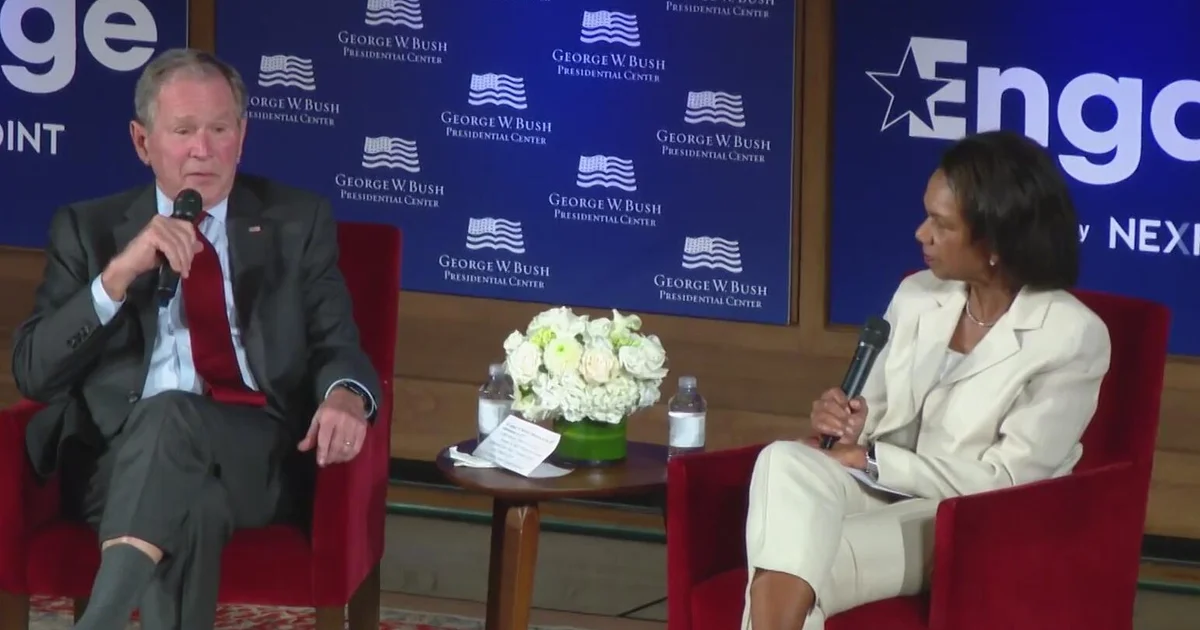
Former President George W. Bush addressed American public sentiment regarding the 25th anniversary of the September 11th terrorist attacks on Wednesday, offering a perspective marked by a measured skepticism of widespread apathy concerning the event. In a rare statement delivered at his presidential library, Bush stated, “Our nation occasionally goes through periods of isolationist thought, where the attitude is, ‘Well, we’ve got too many problems at home. Therefore, who cares about what happens overseas?’” He elaborated that this mindset, he believed, contributed to a lack of focus on the lessons learned from 9/11. Bush asserted that the attacks had fundamentally altered the nation’s security calculus, emphasizing the importance of safeguarding American national security, even if it meant limiting military involvement. He further pointed out that the U.S. should not send troops, but rather stand alongside them to demonstrate solidarity with the nation recovering from the 250-year-old conflict. He suggested that the U.S. government should at least maintain a presence to support the nation’s recovery, referencing the War in Afghanistan, which began after the attacks and continued for twenty years, eventually concluding with the withdrawal of U.S. troops in 2021. Bush detailed the initial events of the 9/11 attacks, describing them as a ‘war, and that the job of the president and the country and his team is to rally the nation and to do what’s necessary to protect our people.’ He recalled visiting an elementary school on September 11, 2001, when his then-chief of staff, Andy Card, informed him about the attacks. In that moment, Bush stated, “I became a wartime president, and this was a war, and the job of the president and the country and his team is to rally the nation and to do what’s necessary to protect our people.” He also recalled the orders to land planes or shoot them down, and the subsequent transportation secretary Norman Mineta’s attempt to land planes on a legal pad, as the vice president struggled to confirm whether Flight 93 had been shot down. Bush acknowledged that the vice president was trying to get confirmation, and for 10 minutes, the administration thought they’d shot down a civilian aircraft. He then stated that the plane crashed in a field in Shanksville, Pennsylvania, after passengers tried to wrest control from the hijackers. He said that the plane was never shot down, and that the vice president kept trying to get confirmation. Bush reiterated the importance of the nation returning to normal after the attacks, emphasizing the need to ‘remember how precious they are.’ He also discussed a sense of trauma that wasn’t fully realized until he went there. He visited a mosque shortly after the attacks, concerned about the harassment of women of color in Michigan, and indicated that the events of 9/11 highlighted a growing ideological struggle between freedom and tyranny. Bush stated that he had to shift to a ‘Sept. 12’ mentality to protect the country, and that people now don’t understand the heaviness of the days after 9/11 in trying to protect the country. He concluded by emphasizing the need to defend freedom and to remember the sacrifices made to preserve it. According to a report from the Transportation Secretary, Norman Mineta, the subsequent shift to a ‘Sept. 12’ mentality was part of a strategy to prevent another attack, as the U.S. government had to go on the offense to protect the country. The analysis indicates that the government’s focus shifted to defending freedom and the nation’s values, with the 9/11 attacks serving as a catalyst for a new strategic approach, and the events of that day significantly altered the nation’s priorities.”}”””””””””””””””””””””””””””””””
Watch Related Video
Source: CBS News