





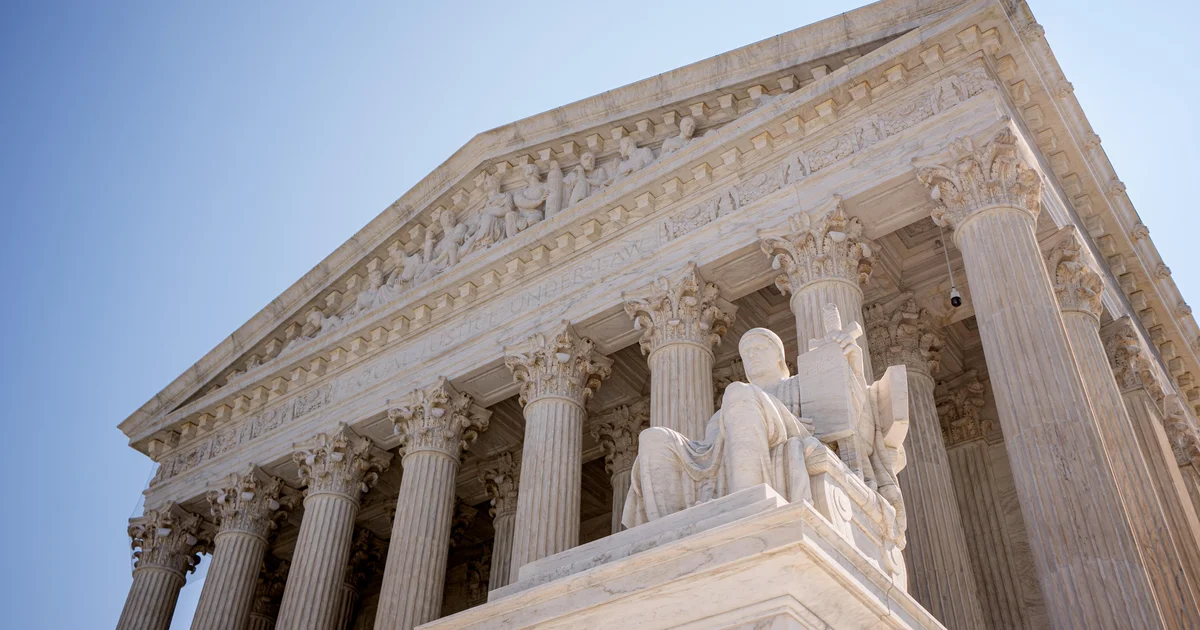
The Supreme Court issued a temporary injunction on Thursday halting Missouri’s implementation of a newly drawn congressional map, effectively preventing the state from utilizing a map favoring Republicans in this year’s midterm elections. The order, unsigned and without detailed dissenting opinions, directed Secretary of State Denny Hoskins to utilize the 2022 congressional map, rather than the newly created map designed to favor Republicans and eliminate seats held by Democrats. Missouri currently has six Republican and two Democratic representatives in its U.S. House delegation, and the new map targets one of the Democratic seats, which could result in a 7-1 split favoring Republicans. The proposed map targeted the seat of longtime Rep. Emanuel Cleaver. The decision, for now, blocks a lower court decision by Missouri’s U.S. District Judge Stephen Clark, who said Tuesday that Hoskins must utilize the map. Late Thursday, Clark refused to stay his order, and a panel of judges on the Eight Circuit Court of Appeals is currently overseeing an appeal of his order. The justices did not offer a rationale for the block, though minutes before the order, lawyers for Hoskins and Missouri stated that it would be ‘extraordinarily burdensome’ to change the congressional map after the state’s August primary elections were held using the new, Republican-created map. The state said that the legal challenge was ‘seeking to destabilize’ the state’s midterm elections, and risked the ‘disenfranchisement of hundreds of thousands of voters.’ Earlier this week, Justice Brett Kavanaugh rejected an appeal from Hoskins, and sided with Missouri’s Supreme Court, which said last week that the new districts cannot be used in the November midterms. The Missouri Supreme Court unanimously ruled in favor of challengers to the new map, ordering statewide vote they requested. Missouri’s highest court said a petition circulated by a group called People Not Politicians that demanded a statewide vote before the congressional map was implemented superseded the new map. The new map was enacted by Missouri Republicans last year as part of a nationwide redistricting effort undertaken by President Trump and Republicans to hold the slim GOP House majority in Congress. Similar redistricting efforts were undertaken in Texas and North Carolina by Republicans, and in California by Democrats. A voter-approved ballot initiative to redraw Virginia’s map to be more favorable to Democrats was rebuffed by the state’s Supreme Court. The court’s decision represents a significant shift in the political landscape, potentially impacting the balance of power in the House and raising questions about the stability of the midterm elections. The implications of the block extend to voter turnout and the potential for a significant shift in the election results. The decision underscores the intense political maneuvering surrounding redistricting in these states, particularly as the November elections draw nearer. The legal battle, which began with a challenge to the new map’s initial implementation, now centers on whether the state’s court has the authority to alter the congressional district boundaries, given the existing voter-approved ballot initiative. The Supreme Court’s intervention is expected to intensify the debate about fair representation and the potential for partisan manipulation in the election process.” , , , , , , , , , , , , , , , , , , , , , , , , , , , , , , ,
Watch Related Video
Source: CBS News