





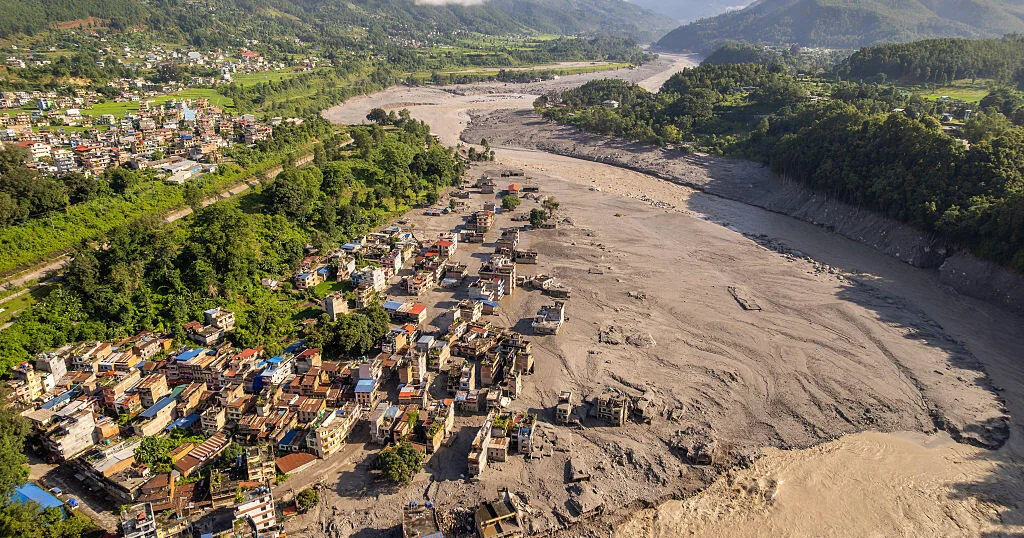
Wednesday’s catastrophic flash floods in Nepal and along the border with China have tragically surpassed 600 confirmed deaths, with an estimated 3,000 individuals still missing, as rescue operations entered their fourth day. The situation has been exacerbated by unrelenting and worsening weather conditions, significantly hindering aerial rescue efforts for personnel and military specialists working tirelessly to locate survivors in the severely affected areas. Brig. Gen. Raja Ram Basnet, a Nepali Army spokesperson, stated Saturday that helicopter operations were on hold until weather conditions improved, a critical decision considering the immense mud and limited landing areas preventing access to vulnerable areas.
Basnet emphasized that authorities believe more than 100 people are trapped in a tunnel filled with thick mud at a hydropower construction site in Nepal’s Rasuwa district. A video from the scene revealed rescuers pulling and pushing a man covered in dark brown mud out of the tunnel, identified as one of dozens likely trapped inside. A helicopter carrying a basket was deployed to reach some people, but the operation was significantly slowed by an unprecedented 4 to 5 feet of mud and restricted landing areas.
Nepali and Chinese authorities have warned that further risks of flooding from a new lake that has formed upstream following Wednesday’s disaster, urging people in potentially affected areas to relocate to safer ground. The risk of another flash flood has also forced rescue teams to temporarily relocate, with experts warning that the lake was starting to overflow, threatening to further inundate the region. More than 3,700 people have been rescued in Nepal so far, according to authorities there, while China’s state media reported 558 missing individuals on the Chinese side. Hundreds of the missing are foreigners, including trekkers, pilgrims, and tourists, who were in the area to work, trek, or make a pilgrimage to a sacred peak on the Tibet side of the border.
The Red Cross reported that some 90,000 people had likely been impacted by the flooding, which is believed to have been triggered by the collapse of a rocky ledge and the vast portion of a glacier it had supported. Scientists are still piecing together information from satellite and ground-level data to confirm precisely what caused the flood, but Jakob Steiner, a geoscientist at the University of Graz in Austria, stated that a lower part of a glacier has really come off. The rocks and melted water suddenly swelled the rivers in the valleys below, causing torrents of water that swept buildings, bridges, and earth downstream in Tibet and Nepal. Scientists were still attempting to confirm exactly what caused the flood, but Steiner said "a lower part of a glacier has really come off."
The Hindu Kush Himalayan region is warming rapidly, driving major changes in glaciers, snow cover, permafrost, and mountain slopes, according to climate scientists. Approximately 78% of the glacier area, located between about 14,760 and 19,685 feet above sea level, is highly exposed to warming. Steiner said "What happened yesterday is unfortunately the new normal. It’s going to get worse from here onwards," he stated.
Five Americans have made their way to safety, and around 90 are among those unaccounted for, the U.S. State Department said Friday. In a statement, the U.S. Embassy in Nepal said the U.S. was "delivering a range of supplies requested by the Government of Nepal and is working with Nepal to ensure that assistance reaches the people who need it." Catholic Relief Services, working through implementing partner Caritas Nepal, will deliver more than 2.5 metric tons of food supplies, 500 blankets, 500 mosquito nets, and 500 insulating foam sheets for temporary shelter flooring to two school locations in Rasuwa, and plans for subsequent supply shipments were already in place. 22 people from the U.S. were among the 80 who went missing from a pilgrimage run by the Isha Foundation, a volunteer-run group that promotes well-being founded by Indian spiritual leader Sadhguru Vasudev. She was crossing from China into Nepal when the flood hit. The foundation told her she was part of a group that was present at the Gyirong Port immigration complex. President Trump called the flooding terrible to see on Thursday, saying that "strong, well-built buildings were wiped out like they were toothpicks." He told reporters in the Oval Office that U.S. officials had spoken with Nepalese leaders and offered to provide "anything they want."
Watch Related Video
Source: CBS News