





A delegation of the African Union recently spent some time in the country on a very important mission over claims that ours was a xenophobic and Afrophobic society.
Under the auspices of its African Commission on Human and Peoples’ Rights, the AU sent a high-powered delegation to our shores between September 28 and October 2 to test allegations that South Africans had a xenophobic and Afrophobic DNA.
The AU obviously felt obligated to send a fact-finding team after it was petitioned by countries such as Ghana and other West African countries for action to be taken against Pretoria following the anti-migration protests that took place in the country earlier this year.
During its mission, the AU delegation spent five days meeting key government, parliamentary and civil society stakeholders over the issues.
They also made time to peruse the country’s migration laws and related policies, while they also did in-loco inspections at deportation centres such as Lindela on the West Rand.
At the end of it all, the African Commission on Human and Peoples’ Rights issued a highly significant yet inadequately noticed report.
It debunked the perception held by Accra and its allies that South Africa was a xenophobic society.
It found that the anti-migration protests that took place this year were vastly different from those that unfolded several years ago in 2008 and 2015, given the current state of the economy.
The finding backs up the point many a patriot has been making that South Africans have been co-existing with other Africans from elsewhere for decades on end within our shores, including during the apartheid era.
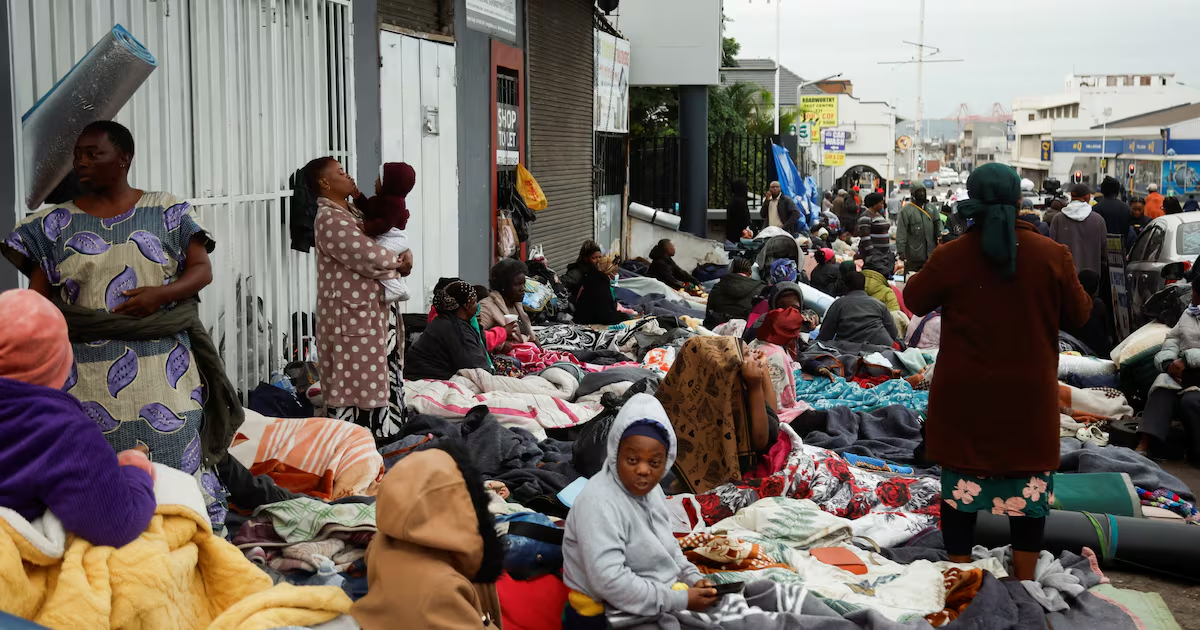
In a communique on Monday, the commission rejected “any suggestion that South Africa is inherently xenophobic or Afrophobic or unique in experiencing incidents of xenophobia or Afrophobia, the recurrence in 2026 of similar incidents of xenophobic and Afrophobic attacks of earlier years that particularly affected nationals of other African states in South Africa taking the form of anti-immigrant protests and community mobilisation, incidents of violence, intimidation and discrimination resulting in loss of lives, destruction of property and sources of livelihoods, (and) separation of families and displacement”.
It is a powerful statement that ought to be welcomed, coming from a non-partisan body mandated by the continental institution, one of whose main objectives is to foster greater unity, cohesion and solidarity among Africans nations.
The finding backs up the point many a patriot has been making that South Africans have been co-existing with other Africans from elsewhere for decades on end within our shores, including during the apartheid era.
And so, those who have been arguing that Ghana’s push for the AU to sanction Pretoria was justified have not been vindicated by the AU’s fact-finding team.
But the AU delegation did not turn a blind eye on the other critical matters.
It has instead, rightly so, demanded more action from government in terms of better managing migration issues.
It has pointed to the emergence of “financed and politicised vigilantism” as forces behind the anti-migration protests, “pervasive corruption” at departments such as Home Affairs and the Border Management Agency and the slow processing of applications from refugees and asylum seekers.
It has also slammed government for having no legislation in place to criminalise illegal mining, recommending that all these be corrected.
This is wise counsel for the government, and we hope it will be heeded as a continued demonstration that indeed ours is a society not “inherently” hateful of our brothers and sisters.
Failure to act on the AU mission’s recommendations will keep fanning the anti-migration fires.



